On 12 October 2025, Slovenia and other EU countries started implementing the Entry/Exit System (EES) at the external Schengen border, in accordance with Regulations (EU) 2017/2226 and 2025/1534. The new border management system was introduced gradually, with full implementation by 10 April 2026, and makes travelling to Europe easier and border checks more efficient.
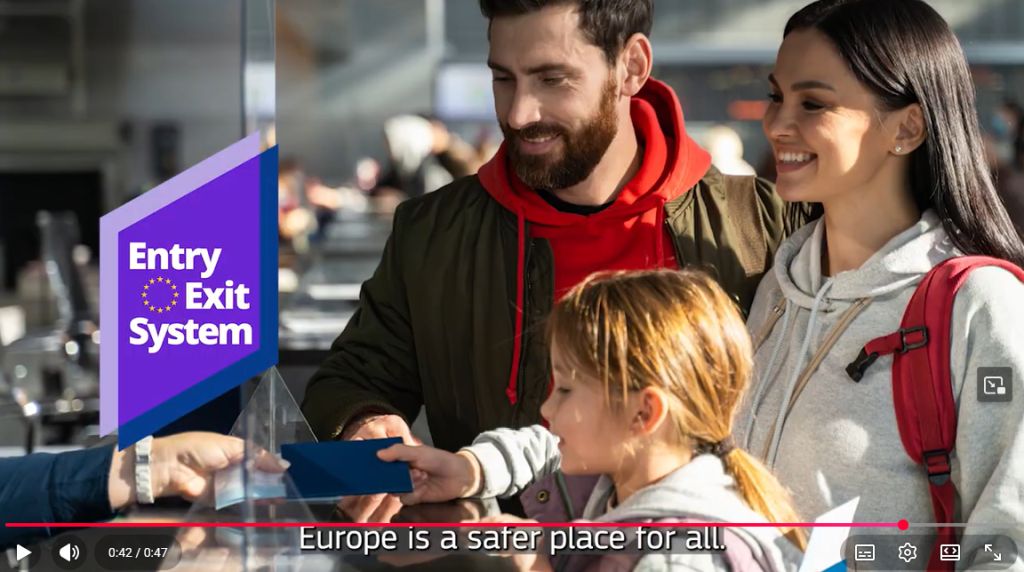 Watch the video
Check how long you can stay – online tool for travelersTravelers can now use new online tool allowing third country nationals subject to EES to check their authorised stay. It allows visa holders and visa-exempt travellers to use the new interactive tool to calculate their remaining authorised stay: https://travel-europe.europa.eu/ees/check-how-long-you-can-stay When consulting the EES online tool, you will receive information on whether your entry is allowed ('OK' or 'not OK'), as well as information about the number of days that you are still allowed to stay on the territory of the European countries using the EES. Travellers will be made aware that their visits, if initiated prior to 10 April 2026, will not be taken into account by the online tool. |
Advantages of the new system
The current practice of often time-consuming manual passport stamping upon entry into and exit from the Schengen area is largely replaced by a fully automated digital system. The system modernises border checks by electronically registering entry, exit, and refusal of entry data of third-country nationals. Border checks also include the verification of biometric identifiers of travellers crossing the external Schengen border.
This increases the effectiveness of border controls in the fight against cross-border and organised crime, terrorism, identity fraud, and illegal residence across the European Union.
The EES was phased in gradually over six months
Slovenia has gradually introduced the Entry/Exit System at border crossing points on its external Schengen border. These include three border crossing points for international air traffic (Ljubljana Brnik, Maribor Slivnica, and Portorož) and at two border crossing points for international maritime traffic (Koper and Piran). At all of these border crossings, the EES system has been fully operational since 10 March 2026.
The phased rollout began on 12 October 2025. The gradual introduction ends on 10 April 2026, when the system becomes fully operational in all Member States.
From 10 April 2026, entering data into the EES system is a mandatory part of border control for third-country nationals, who are required to use the system every time they cross the state border. Slovenia and all other Schengen Area member states use the Entry/Exit System at border crossing points at the external Schengen border, when verifying the legality of third-country nationals’ residence, in the work of administrative and asylum authorities (issuance of residence permits), at Slovenian diplomatic and consular missions abroad , and in the operation of the ETIAS system of travel authorisations.

During border checks the biometric data is also collected for the examination of entry conditions
In addition to travellers' personal data, biometric identifiers (facial image and 4-finger fingerprint) is also stored in the Entry/Exit System. They are used to verify and confirm the identity of travellers each time they cross an external Schengen border or when checking the legality of their stay within the EU, as well as when issuing residence permits at administrative units or visas at diplomatic or consular missions of member states.
The rights of the individual with regard to processing of personal data in the Entry/Exit SystemTravellers' biometric data is collected directly during border checks at the external borders, and travellers are required to enable the collection of their data. For more information see:
|
Carriers use an app to check travellers
With the entry into operation of the Entry/Exit System, all carriers transporting travellers across the external Schengen border are required to verify the personal data of travellers the EES applies to and whether they fulfil the requirements to enter and stay in the territory of the member states using a special app that has been developed for carriers by the EU. Travellers have to provide the carrier (driver or staff) with the information necessary for verification when boarding the means of transport. For more information see: A brochure for carriers about their responsibilities in the EES system
EES does not directly impact other travellers
Slovenian citizens and citizens of other EU and Schengen countries and their family members, as well as third-country nationals who are legally resident in the EU, do not use the Entry/Exit System. Special border control lanes are used for the EES, so the implementation of this system does not have a major direct impact on other travellers.
Related content
For more information visit the official EES website: Entry/Exit System (EES)
An official brochure with info on the EES
Entry and residence
Information for foreigners
State border control and compensatory measures
Border crossings and Schengen regime in Slovenia
Check how long you can stay – online tool for travelers